Elimination Method Example 25
The overall techniques we have learned to reduce the size of our dictionary to be equivalent to our parent dictionary can be summarized as follow:
Since words point to entities and information about entities points to entities, then there is no need to have new or additional words, if new entities are not introduced. In other words, in our communication we use words to identify entities, where information about those entities point to them. In this case, if we do not add new entities, where new information does not point to new entities, there is no need to have new or additional words. To better understand the explanation, let's take it like this:
•
•
•
•
•
•
From the model above, let's assume that we have a fixed set of entities with a fixed set of words; as well as information about the entities is fixed. Since no new entity is added, there is no need to have new or extra or additional words. When we do that, we simply manage our dictionary or vocabulary.
Another way to look at it, let's take it like this: communications between me and you where information flows between me and you as shown by this model.
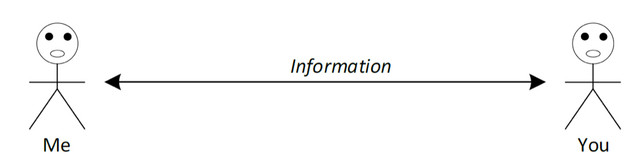
From the above, we can see that information flows in the communication interface. Since no new entity is introduced, no new word is added. So, the flow of information is limited by the existing entities. In this case, extra words are not needed.
Explore More in Natural Dictionary
Practice word elimination and explore the full dictionary in our interactive app.
Open Natural Dictionary App